ADVERTORIAL
"I Drink 8 Glasses A Day – So Why Am I Still Dehydrated?"
After 60, three quiet changes in your body start sending the water you drink straight to your bladder — instead of to the cells that actually need it. Here's the amino acid + electrolyte discovery (the same principle NASA uncovered for its astronauts) that finally fixes it.
By the Hydration Health Review
"Drink 8 glasses of water a day." We've all heard this.
But what if you drink your 8 glasses and STILL feel dehydrated?
Well, here's the reason: the advice you've always heard about hydration is outdated — and sometimes, dead wrong.
After age 60, your body goes through three big changes. These changes make it hard to stay hydrated, no matter how much water you drink.
Chances Are Your Doctor Hasn't Explained These Changes to You
Yet these changes affect every cell in your body. They make it harder to keep water in your body, distribute it, and use it.
That's why people over 60 often feel the symptoms of dehydration — dry mouth, fatigue, fogginess — even when they're doing everything "right."
But there's good news. Scientists have found a simple fix.
Many people who try this fix feel more awake in 30 minutes. They have steady energy all day. And their focus returns.
But here's the most surprising part: they drink less water but stay MORE hydrated.
I know — that sounds counter-intuitive. But once I walk you through the science, it'll make perfect sense.
Let's start with the three biological changes no one talks about — and what to do about them.
Why Your Brain Is Lying (And Leaving You Dangerously Dehydrated)
Deep in your brain lies the control center called the hypothalamus. One of its jobs is to tell you when you need water. When your body needs water, it's supposed to send out a strong "drink now" signal.
But here's what scientists have discovered: as we age, that thirst signal fades.
In one study, older adults who were dehydrated drank 60% less water than younger adults — even though both groups were just as dehydrated. The older adults' brains simply didn't register the need to drink.
It's not just aging, though, that makes you drink less water. Some medications and health conditions can also dampen your thirst signals.
The result? Your body may desperately need water — but you don't feel thirsty. So you don't hydrate.
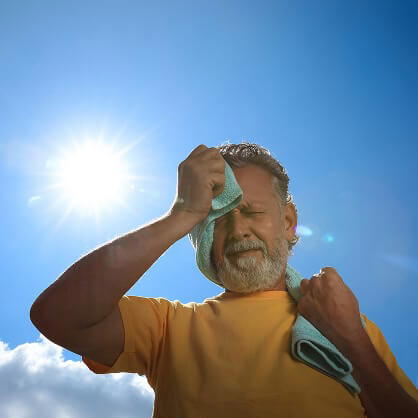
And, believe it or not, when you're dehydrated, your brain shrinks! This makes it harder for your brain cells to talk to each other.
In fact, one study showed that people over 60 who were dehydrated did much worse on attention tests. They scored a whopping 35% lower. That means they got a "D" on a test they should have aced!
Dehydration also affects memory, focus, and reaction time. And you don't have to be extremely dehydrated for this to happen. Even losing just 1% of your body's water can slow you down.
Believe it or not, you can lose that small amount with everyday activities, like walking, cooking, or playing with your children and grandchildren. But there's something even more worrying: even if you do drink water, it might be passing right through you.
How Can You Drink Enough Water and Still Be Dehydrated?
You may think that drinking 8 glasses of water a day will keep you healthy. But for some people that might not be enough. There are three reasons why:
Reason #1: Your kidneys struggle to hold water.
As you may know, your kidneys' job is to remove waste and toxins. Kidneys also control the amount of water in your body. If you have too much water, they turn that into urine.
But, as you age, kidneys find it harder to hold onto water.
This means water leaves your body faster than normal. So you might be drinking 8 glasses of water, but you're still dehydrated.
Reason #2: You're losing essential minerals.
When you lose water, you also lose essential minerals called electrolytes. Electrolytes send water to your muscles, brain, and skin.
They also help your nerves send messages. They help your muscles move and relax. And they keep your heartbeat steady.
What happens when you don't have enough electrolytes? Water doesn't get where it needs to go. And your body doesn't work the way it should.
For example, you might feel dizzy when you stand up. You might get muscle cramps at night. And you might feel confused or have trouble thinking clearly.
These are all red flags of dehydration.
Reason #3: Water struggles to get into your cells.
Here's what most hydration advice misses entirely: water hydrates you only when it enters your cells.
As you may know, your cells are surrounded by a protective membrane. This membrane keeps most things, including water, out of the cell. To stay hydrated, cells rely on the right minerals and amino acids to carry water across that membrane and pull it inside.
Unfortunately, as you get older, this transport system slows down. It's like having a farm where half the irrigation lines are blocked. There's plenty of water in the main supply, but it can't reach the crops that need it.
So your body stays dehydrated at the cellular level — even if you gulp down gallons of water. No wonder studies show that many older adults don't even know they're dehydrated.
And, beyond the obvious symptoms like fatigue, dehydration also leads to other issues that many people dismiss as "just getting older."
NASA Discovered the Same Problem — and a Better Way to Fix It
Few people face dehydration as brutally as astronauts. In space, the body quietly bleeds off water, sodium, and potassium — and the sensation of thirst drops at the same time. Sound familiar? It's the very same trio of problems that creeps up on the body after 50, just compressed into days instead of decades.
Early in the space program, NASA tried the obvious fix: give astronauts water and salt tablets before re-entry. It failed. Those who drank only water simply passed it straight through — no real hydration benefit, just an inconveniently full bladder. Those who took only salt got worse. Plain water, NASA learned the hard way, wasn't enough.
So after years of research, NASA scientists engineered something better: a precise blend of minerals in exactly the right proportions, designed to be absorbed and held by the body rather than flushed away. The breakthrough wasn't drinking more — it was drinking smarter, by pairing water with the minerals that actually pull it into your cells.

Then Sports Science Took It One Step Further

NASA proved that the right minerals beat plain water. But researchers studying soldiers and athletes — the people who push their bodies to the edge of dehydration on purpose — wanted to know what else could move water into the cells faster, instead of straight to the bladder. The answer surprised them: a small amount of sodium paired with amino acids.
It comes down to a mechanism doctors have relied on for decades. When the right ratio of sodium and certain nutrients reaches your gut, it opens a kind of pump in your intestinal wall that pulls water into your bloodstream far faster than plain water can manage on its own. It's the same principle behind the rehydration drinks hospitals use — the ones the World Health Organization calls one of the most important medical advances of the last century. The catch: it only works at the right balance. Too little and nothing happens; too much sodium and you just feel puffy and thirsty.
Then sports scientists added the final piece: amino acids like taurine and glycine, which help usher that water across the cell membrane and keep it there. So the real breakthrough was never a single exotic ingredient — it was getting the proportions right. Enough sodium to open the pump, the amino acids to carry water inside, and none of the sugar overload that sends it rushing back out. Get that balance wrong and you're just drinking expensive water. Get it right, and your body finally holds on to what you give it.
The Hidden Toll of Dehydration
Do you find yourself overheating easily — even when others feel fine? Or breaking a sweat from a short walk or some light gardening? This can happen because dehydration raises your body temperature.
Your body cools itself through sweat. But when you're even mildly dehydrated, sweat production drops. That means your internal temperature rises faster … and stays high longer. Suddenly, normal activities feel exhausting. And heat becomes unbearable.
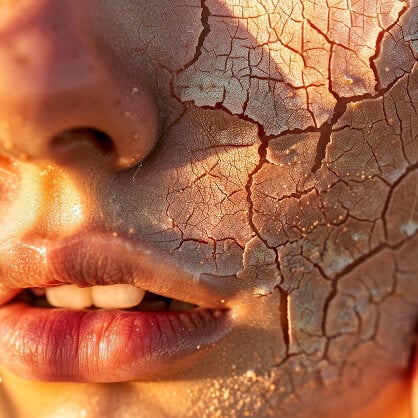
Dehydration also makes your skin age faster. When your skin cells don't have enough water, your skin dries out from the inside. You can try all the skin creams you want. But without enough water inside the cells, nothing works.
At first, dehydrated skin feels a little tight or flaky. But over time, it gets worse. It loses its elasticity and softness. Then it begins to thin. That's when fine lines appear and wrinkles form.
Before you know it, you look older than you feel — simply because you're dehydrated.
Up to this point, we've seen how "8 glasses" is a myth. And there's another myth — one that tricks millions into thinking they're rehydrating, when they're really doing the opposite.
The Big Lie That Leaves You Even More Dehydrated
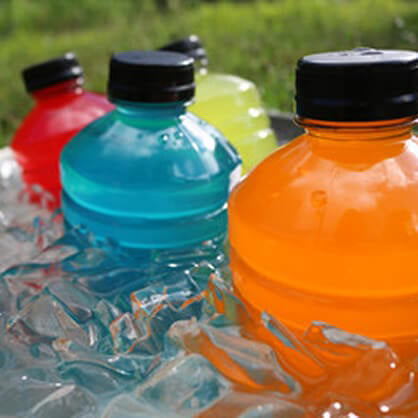
As we explained, electrolytes are essential. They help transport water into your muscles, nerves, and cells. So you might think grabbing a sports drink or electrolyte supplement will help. Well, think again.
Most of these products are made for young athletes, not for regular folks. They're full of sugar — sometimes more than 30 grams per serving. That much sugar is okay for athletes who've just burned thousands of calories and sweated buckets.
But you are not training for the Super Bowl. You just want to feel steady, clear-headed, and hydrated throughout your day.
So here's what actually happens when you grab one of those drinks: first, your blood sugar spikes and crashes. Then, most of the electrolytes you paid for get flushed out before your body can use them.
That's the bad news. But here's some good news — and it starts with what you actually need: just enough high-quality electrolytes to carry water into your cells, the amino acids that help lock it in place, and none of the sugar or excess sodium.
What Changes for You After 60
When your body finally absorbs and holds the water you give it, the difference shows up in ordinary moments — the ones you'd quietly stopped expecting to feel good again.
Sleep Through the Night
Because your body uses the water instead of flushing it, you may finally stop making that 2 a.m. walk down the hall — and wake up actually rested.
Steady, All-Day Energy
No more dragging by 3 p.m. or waking up foggy — just a level, dependable energy that carries you from morning to night.
A Clearer Head
Names, appointments, the thread of a conversation — the small mental slips you blamed on age often have more to do with hydration than you'd think.
Steadier on Your Feet
Stand up without the room swimming. Well-hydrated muscles and nerves help you move with confidence instead of caution.
Easier, Deeper Nights
Fewer leg cramps, fewer interruptions, nutrients like glycine that calm the body — the kind of deep rest that leaves you recovered.
Bounce Back Faster
After a walk, gardening, travel, or a day with the grandkids, you recover quicker — less time resting, more time living.
The Doctor Who Set Out to Build a Better Way to Hydrate

"Most electrolyte drink mixes contain way too much sodium for the average person. I saw the need for a formula created specifically for day-to-day hydration — not for athletes pouring sweat for hours."
That's Dr. Chad Walding, Doctor of Physical Therapy and co-founder of NativePath. For over a decade he's helped patients — many of them over 55 — stay strong, steady, and independent as they age. And hydration kept coming up as the quiet factor holding people back.
His approach married the two discoveries you just read about: the precise, absorbable minerals NASA proved beat plain water, and the amino acids sports science showed help pull fluid into cells and keep it there. "By encouraging your body to actually absorb these minerals," he explains, "you can restore hydration, muscle strength, energy, and balance from the inside."
Introducing NativePath Hydration Formula - The Formula That Gets the Balance Right
Everything you've just read — the fading thirst signal, the kidneys that can't hold water, the cells that can't pull it in — points to one fix: the right minerals and amino acids, in the right proportions. That's the entire reason Dr. Walding built NativePath Native Hydrate.
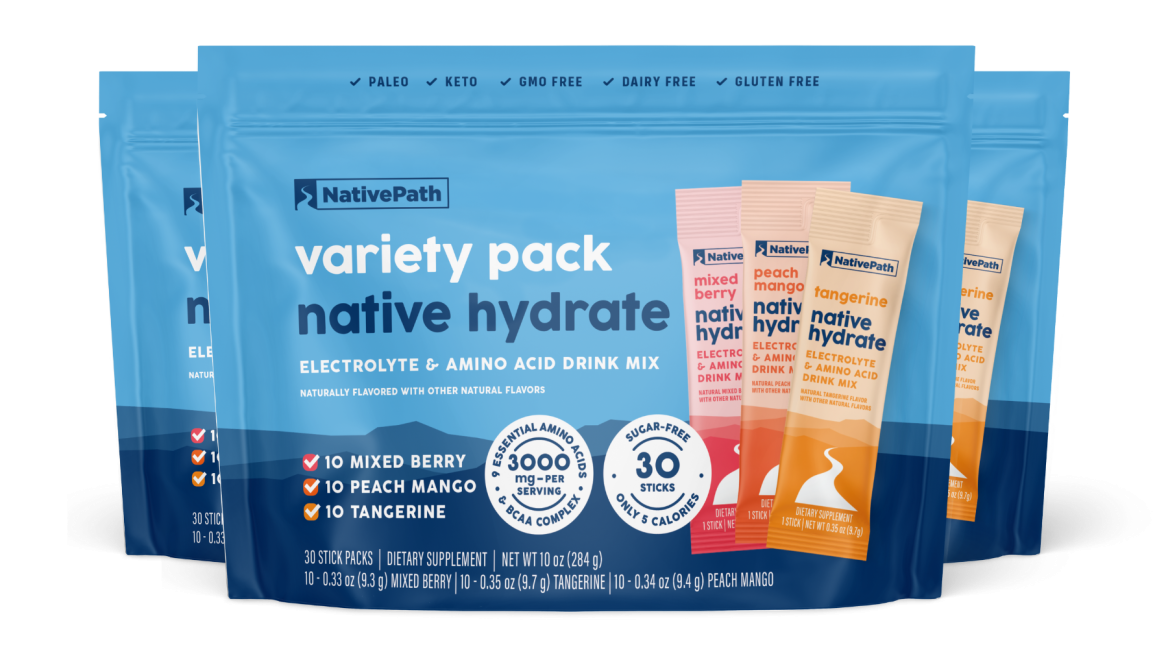
Each serving floods your body with around 3,000 mg of high-quality amino acids and pure electrolytes — and just 200 mg of sodium, less than a quarter teaspoon. It's the balance Dr. Walding was after: enough to drive water into your cells, without the sodium overload of a sports drink.
Because absorption drops with age, the formula doesn't stop there. It layers in 11 additional vitamins — 29 nutrients in all — including B12, biotin, folate, zinc and glycine, chosen to support steady energy, sleep, nerve and muscle function, and healthy aging. No added sugar. No artificial colors. Sweetened only with a touch of stevia, at just 5 calories a serving.
As Easy as Stir, Sip, Done
No blender, no mess, no routine to overhaul. Each single-serve stick pack travels with you and mixes clump-free in seconds.
1
Stir in 1 stick pack. No blender required.
2
Add to 12–16 oz of water. Mixes clump-free.
3
Enjoy up to twice daily. Morning, night, or both.
Three Flavors Worth Looking Forward To
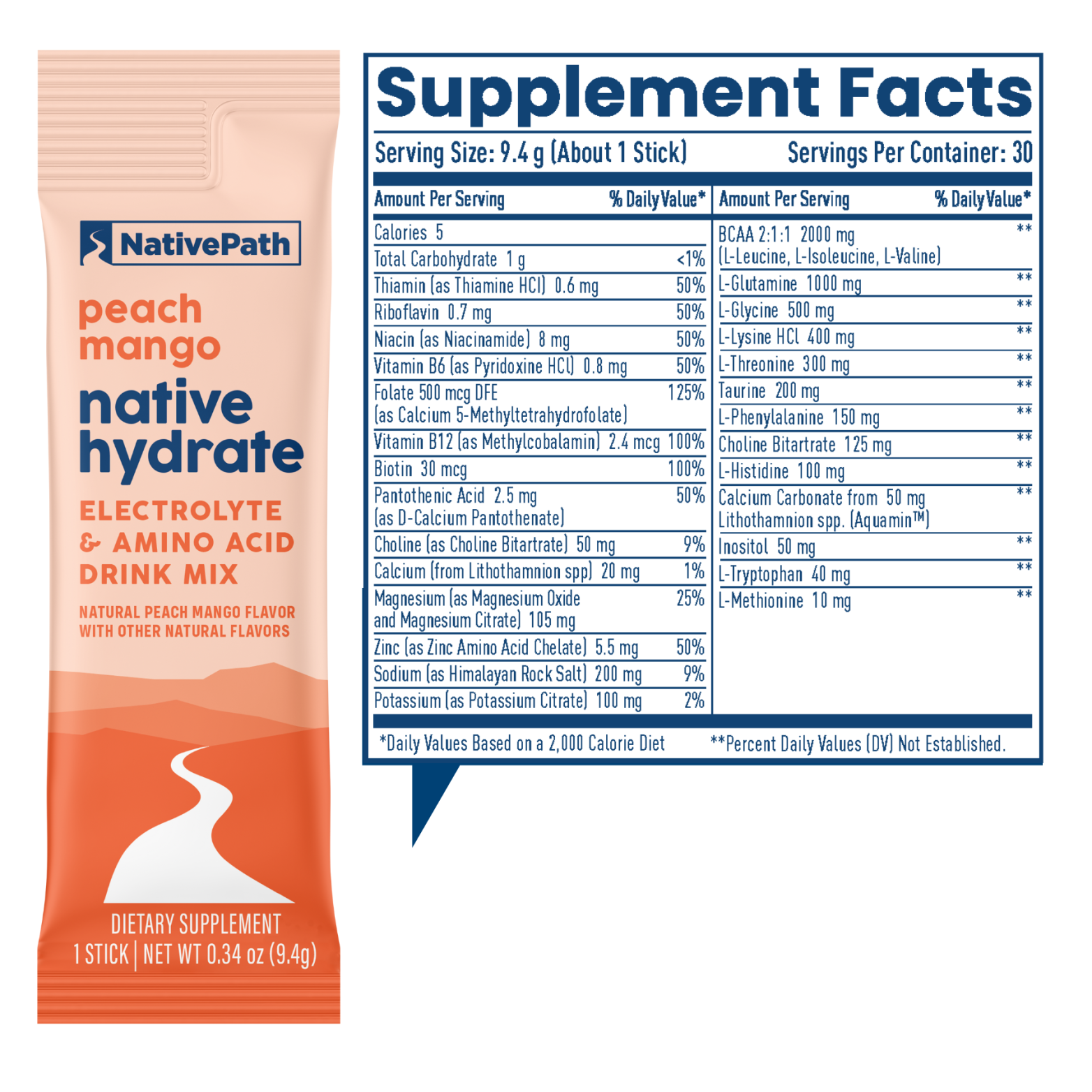
Peach Mango
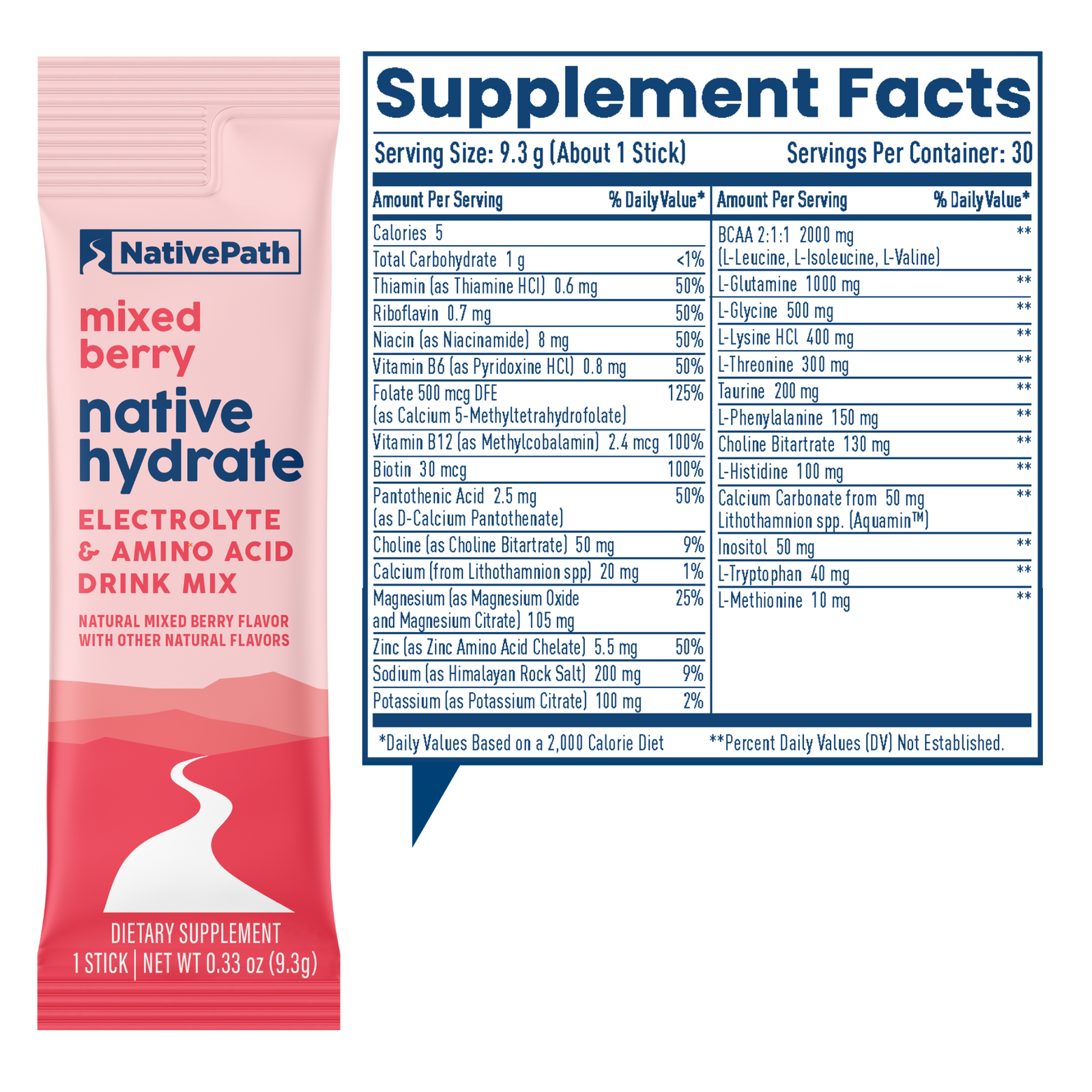
Mixed Berry
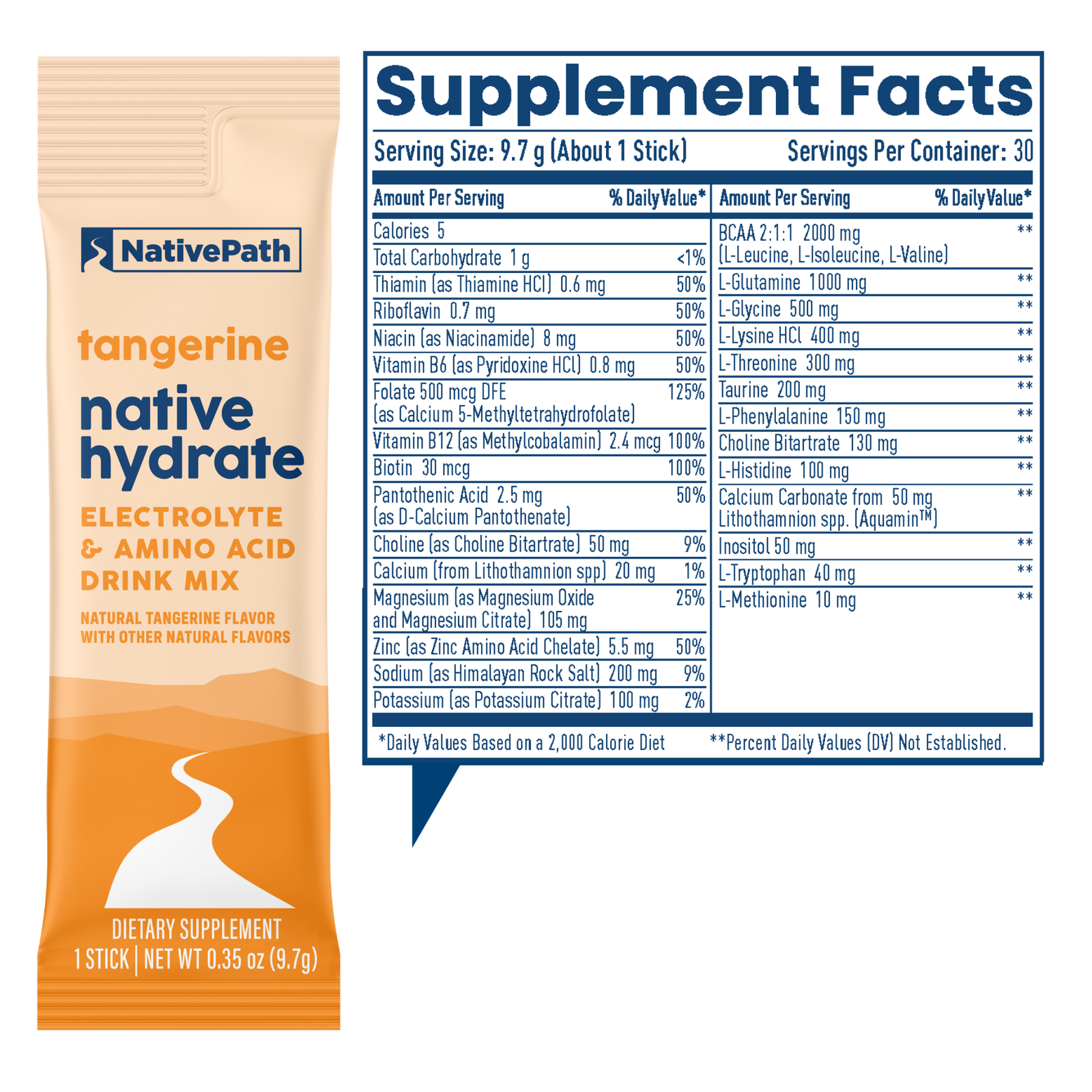
Tangerine
Stop Drinking More — Start Absorbing More
You've seen the science: after 60, plain water isn't enough — your cells need the right amino acids and electrolytes, in the right balance, to actually absorb and hold it. That's exactly what NativePath Native Hydrate delivers, in a clump-free stick pack that takes seconds a day. Because the highest-quality amino acids are tightly sourced, stock runs low often — so it's worth securing yours while it's available.
Backed by a 365-Day Money-Back Guarantee
Try it for a full year. If you're not completely satisfied for any reason, NativePath's Customer Care team will refund you — no risk, no strings. Every order ships free within the U.S. The only real risk is staying dehydrated.
365-Day Money-Back Guarantee • Free U.S. Shipping • No Subscription
What Customers Noticed After Adding Native Hydrate to Their Routine
Amy E.
R.H.
Patricia S.
Gina G.
Barbra F.
Karen K.
Annette Z.
Catherine S.
Jimmy T.
Sarah S.
*Customer results have not been independently verified. Individual results may vary.
Frequently Asked Questions
What makes Native Hydrate different from other electrolyte drinks?
How does it actually work?
Will this make me retain water or feel bloated?
Will it make me run to the bathroom more?
How much should I take, and what does it taste like?
How long until I notice results?
What if it doesn't work for me?
Disclaimer: These statements have not been evaluated by the Food and Drug Administration. This product is not intended to diagnose, treat, cure, or prevent any disease. The information on this page is for general information purposes only and is not a substitute for professional medical advice, diagnosis, or treatment. Always consult your physician regarding any medical condition or before starting a new supplement.
Customer Support: 1-800-819-2993 • cs@nativepath.com
1395 Brickell Ave. Suite 800, Miami, FL 33131